PREP INTERVU — AI-Assisted Interview Platform

PREP INTERVU — AI-Assisted Interview Platform

Preparing students for high-stakes interviews through structured mock interviews, AI-assisted feedback, and consultant-led coaching.

July – Aug 2025 · 2 months

Sole Designer

B2B SaaS · Product Design

Figma · Claude

OVERVIEW

I was the sole UI/UX designer for PREPINTERVU, an AI-assisted interview platform that helps education consultants conduct structured mock interviews and deliver meaningful feedback to students. Over 1.5 months, I designed end-to-end experiences for both consultants and students.

Consultant dashboard - the starting point

PROBLEM
Interview preparation is often unstructured and difficult to scale.

Students rarely receive structured practice or actionable feedback, while consultants spend significant time manually scheduling, conducting, and reviewing mock interviews.

The challenge was to create a system that supports both sides of the experience without increasing operational complexity.

GOAL

Design an AI-assisted interview platform that enables consultants to conduct structured mock interviews at scale while giving students a guided, low-anxiety experience with meaningful feedback.

My Role

As the sole product designer, I designed the product from MVP to production-ready UI by:

  • Defining user flows and information architecture

  • Designing consultant and student experiences

  • Collaborating closely with founders and engineers

  • Iterating throughout development

Workflow

Requirements → User Flows → Wireframes → Visual Design → Development Iterations

The platform serves two distinct user groups with different goals. Rather than designing a single experience, I created separate workflows for consultants managing interviews and students preparing for them. This separation helped reduce complexity while keeping each interface focused on the user's primary tasks.

#1 Structuring the Consultant Workspace

The problem

Consultants needed to manage multiple students, interviews, and templates without constantly switching between different tools.

My approach

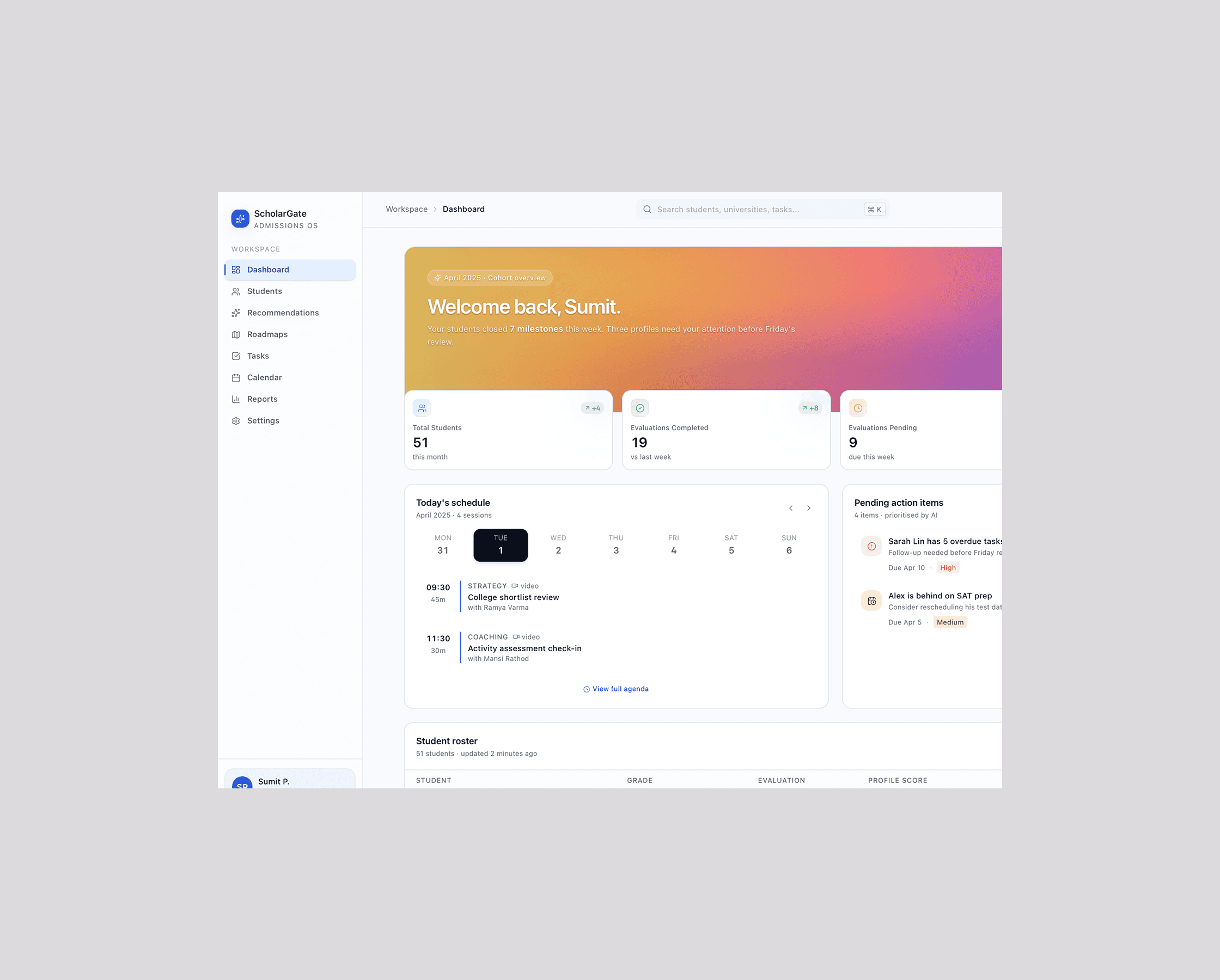
I designed a centralized dashboard that surfaces upcoming interviews, pending actions, and quick access to frequently used tasks.

Outcome

Consultants could understand their workload at a glance while reducing unnecessary navigation.

Consultants get a centralized view of interviews, pending reviews, and daily priorities.

Consultants get a centralized view of interviews, pending

reviews, and daily priorities.

#2 Managing Students at Scale

The problem

As the number of students increased, manually tracking interview history and progress became difficult.

My approach

Student profiles consolidate interviews, resources, feedback, and preparation history into a single workspace.

Outcome

Consultants could easily move between planning interviews and reviewing individual student progress.

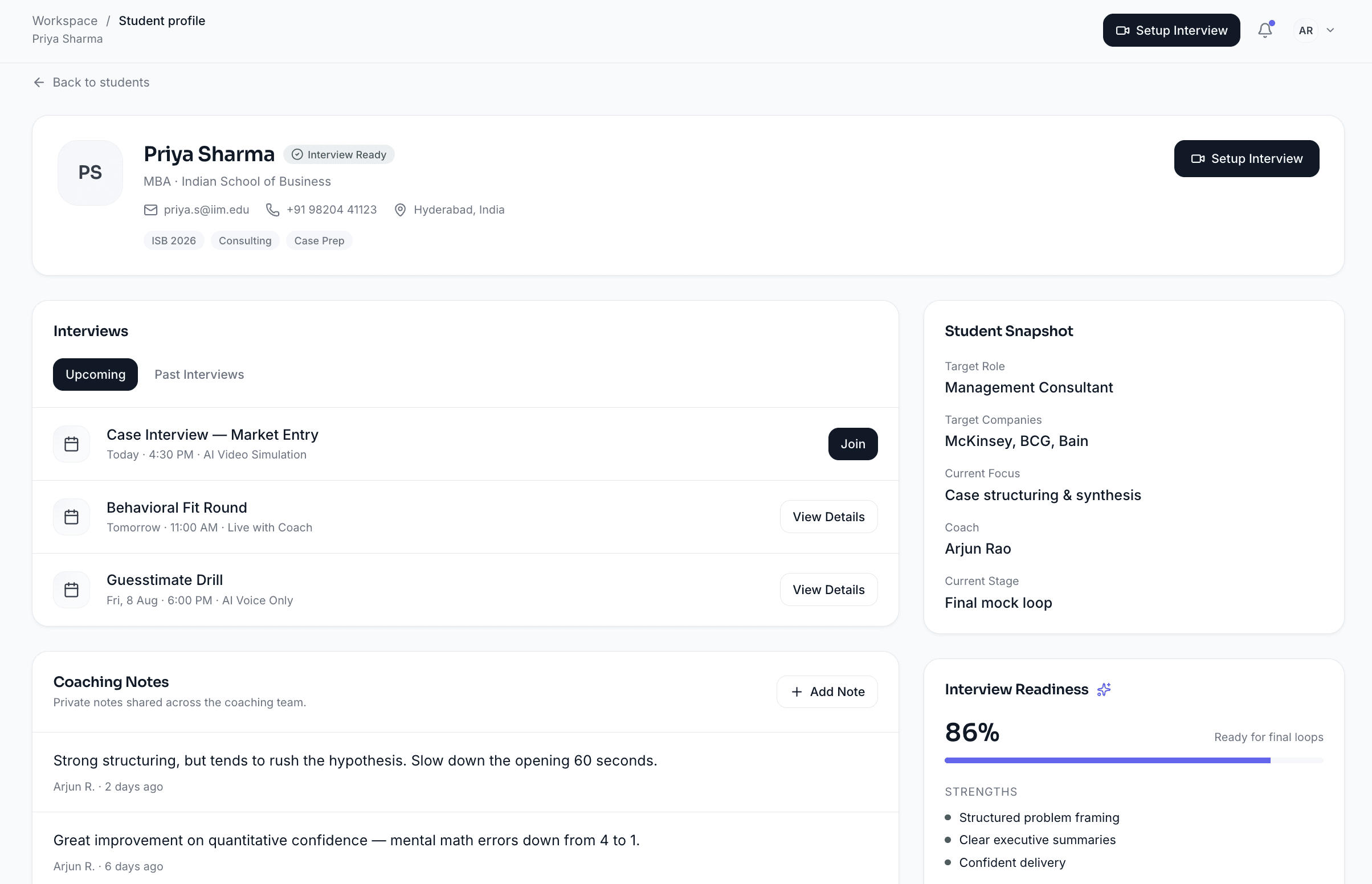
A consolidated student profile brings together interview history,

coaching notes, and readiness in one place.

A consolidated student profile brings together interview history, coaching notes, and readiness in one place.

#3 Creating & Assigning AI Interviews

The problem

Consultants needed a fast way to assign personalized AI interviews without repeatedly configuring every detail from scratch.

My approach

I split the workflow into two focused steps. The first captures interview details and settings, while the second helps consultants build the interview using reusable question libraries and AI-powered insights. Breaking the process into smaller decisions reduced cognitive load and kept the experience flexible.

Outcome

Consultants could create personalized interviews quickly while remaining in complete control of the final question set. AI supported the workflow with recommendations and analysis rather than making decisions on their behalf.

Consultants assemble interviews from reusable questions

while AI analyzes coverage, difficulty, and estimated duration.

Consultants assemble interviews from reusable questions

while AI analyzes coverage, difficulty, and estimated duration.

Configure interview details, deadline, and AI settings before building the interview.

Configure interview details and AI settings before building the interview experience.

Configure interview details and AI settings before building the interview experience.

Build personalized interviews using reusable question libraries while AI provides real-time insights.

Configure interview details and AI settings before building

the interview experience.

Build personalized interviews using reusable question libraries

while AI provides real-time insights on interview quality.

#4 Reusable Interview Templates

The problem

Creating interview questions from scratch for every session was repetitive and inconsistent.

My approach

I designed reusable interview templates that organize questions, industries, and interview types into reusable structures.

Outcome

Consultants could standardize interview quality while significantly reducing setup time.

Consultants assemble interviews from reusable questions while AI analyzes coverage, difficulty, and estimated duration.

Consultants assemble interviews from reusable questions while AI analyzes the technicality

Consultants assemble interviews from reusable questions

while AI analyzes coverage, difficulty, and estimated duration.

#5 Creating a Calm Student Experience

The problem

Interviews naturally create anxiety. Students needed clarity before, during, and after each session.

My approach

The student workspace focuses only on what matters—upcoming interviews, preparation resources, interview status, and completed feedback.

Outcome

Students always know what comes next without being overwhelmed by unnecessary information.

Personalized milestones transform AI suggestions into an actionable study abroad journey.

#6 Making Feedback Actionable

The problem

Generic interview scores rarely help students improve.

My approach

AI-generated feedback is organized into strengths, improvement areas, transcripts, summaries, and actionable suggestions. Consultants review feedback before it is shared with students.

Outcome

Students receive feedback they can immediately apply while consultants retain full control over the evaluation process.

AI-generated feedback highlights strengths, improvement areas, and actionable next steps after every interview.

A progress-focused workspace that helps students stay informed, motivated, and on track.

AI-generated feedback highlights strengths, improvement areas, and actionable next steps after every interview.

Consultants assemble interviews from reusable questions

while AI analyzes coverage, difficulty, and estimated duration.

OUTCOMES
The platform launched and is in use with real education consultants and students.
  • Successfully launched as a standalone AI interview platform.

  • Later integrated into the broader ScholarGate ecosystem.

  • Reduced manual coordination for consultants while creating a more structured interview preparation experience for students.
What I learned
Designing intelligent systems requires understanding people first.

The AI was the headline, but the real work was creating a structure that made consultants feel confident and students feel supported.

Three key learnings:

  1. Trust is a design concern, not just a feature. When introducing automation, explainability and transparency aren't nice-to-haves—they're fundamental to the system working.

  2. Clarity beats features every time. The temptation was to add more recommendations, more metrics, more customization. But every feature added should reduce friction, not create it. I had to push back constantly on complexity.

  3. Keep humans in the loop. The most powerful systems don't replace human judgment—they enhance it. By keeping consultants in control (even if just through validation steps), adoption and trust increased dramatically.


If I'd do it again: I'd push for earlier, more direct user access. The PM was excellent, but observing real consultants and students would have caught assumptions faster and validated ideas before they became built features.

Designing intelligent systems requires understanding people first.

Designing an AI-assisted interview platform reinforced that AI works best when it supports—not replaces—human expertise.

Consultants remained central to the experience by reviewing AI-generated feedback before it reached students, helping build trust without removing automation.

Working across two distinct user roles also highlighted the importance of defining role boundaries early. Designing consultant and student journeys independently made both experiences significantly simpler and easier to navigate.

If I revisited the product, I would explore longitudinal analytics that help consultants identify interview trends and track student improvement across multiple mock interviews rather than evaluating sessions in isolation.

The AI was the headline, but the real work was creating a structure that made consultants feel confident and students feel supported.

Three key learnings:

  1. Trust is a design concern, not just a feature. When introducing automation, explainability and transparency aren't nice-to-haves—they're fundamental to the system working.

  2. Clarity beats features every time. The temptation was to add more recommendations, more metrics, more customization. But every feature added should reduce friction, not create it. I had to push back constantly on complexity.

  3. Keep humans in the loop. The most powerful systems don't replace human judgment—they enhance it. By keeping consultants in control (even if just through validation steps), adoption and trust increased dramatically.

If I'd do it again: I'd push for earlier, more direct user access. The PM was excellent, but observing real consultants and students would have caught assumptions faster and validated ideas before they became built features.

INTERACTIVE PROTOTYPE

Experience the full consultant workflow:

Experience the full consultant workflow:

Let's build something meaningful.

Whether it's a product from scratch,
an AI idea, or just a conversation about design,
I'd love to hear from you.

Designed & built by Sindhu Matla.


Still noticing the little things.

Visakhapatnam, India

Let's build something meaningful.

Whether it's a product from scratch,
an AI idea, or just a conversation
about design,
I'd love to hear from you.

Designed & built by Sindhu Matla.


Still noticing the little things.

Visakhapatnam, India

Create a free website with Framer, the website builder loved by startups, designers and agencies.